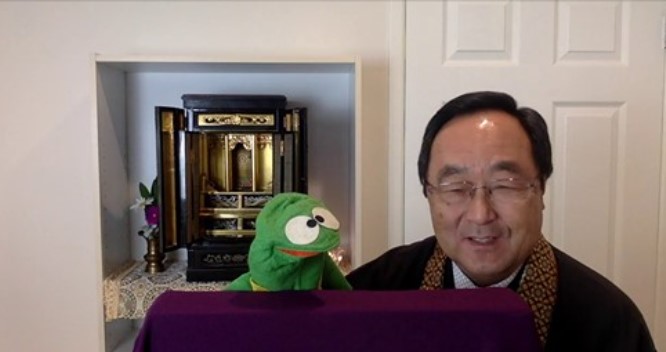
Bishop Harada made a Youtube kids Dharma talk with Freddie the Frog. View it on Youtube here:
A Jodo Shinshu Buddhist Temple
Bishop Harada made a Youtube kids Dharma talk with Freddie the Frog. View it on Youtube here:
Message from Bishop Marvin Harada
The Dodgers and The Butterfly
I am not a huge baseball fan, and during the season, I don’t watch many games, but I love to watch the postseason playoffs and the World Series every year.
This year was even more exciting because the Los Angeles Dodgers were in the playoffs, and then made it to the World Series. I watched every game and they were all so exciting with great pitching, lots of home runs, and stellar defensive plays, by both teams. And I watched the final game in which the Dodgers won the championship and the World Series on Oct. 27.
We can’t help but feel touched to see the winning team run out onto the field and jump for joy like little kids again. It is such a rare opportunity to win a World Series, and those players and coaches no doubt worked so hard to become champions. We also feel for the losing team, as they too worked hard and dreamed of being champions as well.
The Dodgers players were hugging each other, piling on top of each other, just like Little League players would if they won a championship game. I think that is part of what is so moving about seeing such a scene, to see grown adults become little kids again. We can all relate to such a feeling of pure joy.
Buddhism points to the awakened life as like “becoming a child again.” It doesn’t mean that we should become kids and go through the terrible twos again, or anything like that, but what it is trying to say is that children have a real innocence, a sincere heart and mind, that we must “rediscover” as adults. Buddhism is saying that as we age, we lose that childhood innocence, spontaneity, and joy for simple things.
When we were little kids, just to get an ice cream cone brought real joy to us, didn’t it? After we become adults, it takes a four-star restaurant and something like bananas foster or crème brulee to get the same kind of joyous response. An ice cream cone from the local Baskin and Robbins just won’t do it for us.
I will never forget some years ago, when my wife was still teaching elementary school, the school had an annual “Read Across America” program in which teachers would bring in people from the community to read to the kids in the classrooms.
My wife always insisted that I do this and I would go to her kindergarten class and read a few children’s stories. One year, I read a book on “Happiness,” and after reading the story, I thought I would dialogue with the kids a little and I asked them, “What makes you happy?” I thought they would say something like, “Having a birthday party,” or “Getting a new video game,” or something like that.
However, to my great surprise, one little girl said, “It makes me happy when a butterfly lands on my nose!”
I would never say that. Not in a million years. I would say something like, “When I hit a big jackpot in Las Vegas,” or “When I hit a good shot on the golf course,” or “When someone compliments me on my sermon,” or something to that effect. I would never say something like, “When a butterfly lands on my nose.” That is the childlike innocence, spontaneity, and pure joy that children exhibit, that Buddhism says we have lost, but should return to.
Namuamidabutsu,
Rev. Marvin Harada, Bishop, Buddhist Churches of America
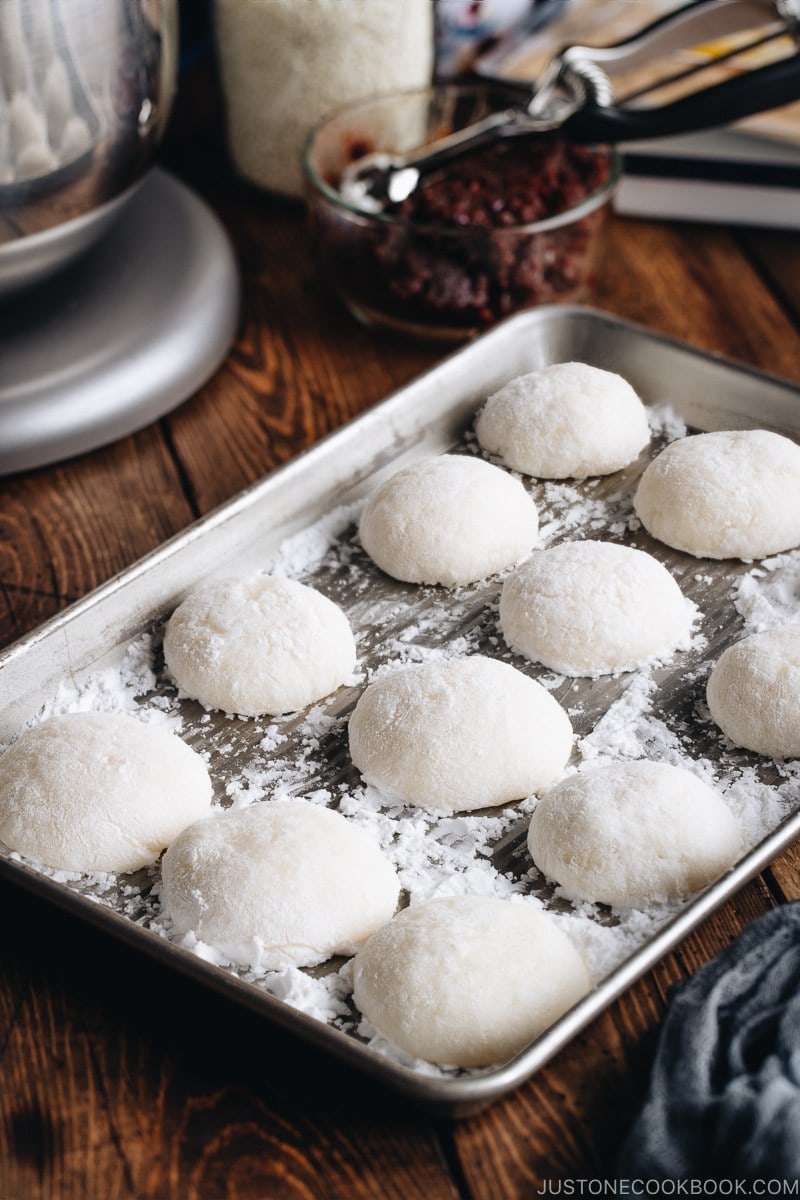
Order Your Traditional Mochi For New Years
4 Pieces/Order – By Donation (Min. $5)
***Order by Sunday December 20th***
Pick up on Sunday, December 27th – 11:30 am – 1 pm
Reservations Required – Limited # Being Made
Email: SpokaneBuddhistTemple@gmail.com
Fundraising for our Minister’s Education
This is a Japanese New Year’s Tradition. Around the start of the New Year, many Japanese households will take part in the annual tradition of mochitsuki, the pounding of rice to make mochi. Mochi, also called a rice cake, is pounded sweet rice that can be eaten in a sweet or savory dish.
Some ideas of what to do with your mochi. Crumble or cube this mochi and add it to:
Miso soup. A typical recipe is 4 cups water or broth, 3 tablespoons miso paste, 8 ounces tofu cubed, sliced green onions for garnish, and (optional) 2 teaspoons dashi granules (dried seaweed & bonita). Boil the broth, add the miso and tofu and cook for 2-3 minutes; add the green onions as garnish.
Ozoni Soup (a thick soup usually eaten on New Year’s Day). Nearly every prefecture in Japan has a different version of Ozoni or Zoni Soup. It could contain tofu, have a miso base, and also contain a variety of meats and vegetables.
Hot Udon noodle soup (made with thick wheat flour noodles).
Or you could toast the mochi and top it with a sweet or savory topping, or add it to any other dish.
Find the December Newsletter on the Newsletter tab or here:
When the Temple closed due to Covid-19 in March, it seemed like the pandemic might fizzle out during the summer months, so we made due with group discussions online and with directing the Sangha to the Seattle Betsuin for virtual services. With Winter on its way and Covid cases surging, the Religious Education Committee and Board met together to re-evaluate the situation. We have decided to move forward with holding virtual services via Zoom.
Services will begin on Nov. 1st at 10:30 am. After service, there will be 2 breakout rooms – one for socializing with one another and a second for discussing the Dharma Talk. We will record services and post them online, if you’re unable to make it during the live portion. Please email the temple at SpokaneBuddhisttemple@gmail.com or melissajoshinopel@gmail.com to be added to the notification list for these services, to get the Zoom login.
If you want to participate, but do not know how to use Zoom, please let us know and we will try and help you get it figured out. Namo Amida Butsu,
Reverend Melissa Opel & MA Chad Donoho
The Meaning of “Arigatai”
Japanese Buddhism is rich with wonderful words and expressions that are hard to translate into English. Words like Okagesama, thanks to others, or mottainai, which can mean “don’t waste,” are hard to truly translate. There is something lost in translation.
There is another beautiful expression that I would like to share and explain today. It is the word, “Arigatai.” Arigatai literally means “hard to exist,” or “hard to be,” as in “rare” or “wondrous.” Buddhism is pointing to the “rare” and the “wondrous” in our lives that we do not see, or take for granted.
The first thing that is rare and wondrous, is life itself. We all know that to win the lottery, the odds of winning are astronomically difficult. Something like 300 million to one. Not one in a million. 300 million to one. Sometimes I wonder why I buy a ticket when the jackpot gets really big, but I dream of hitting the lottery just like everyone else.
Did you ever think about the odds of you being born into this world? Buddhism describes it this way. Imagine that out in the vast Pacific ocean, there is one particular sea turtle. This sea turtle comes to the surface only once in a hundred years. Imagine also, that on the surface of the vast, Pacific ocean, there is one particular piece of driftwood, that has a knot hole in it. Buddhism says that the odds of our being born into this world is compared to the following: What if this one particular sea turtle, when it surfaces once in a hundred years, just happens to hit that one particular piece of driftwood floating out on that vast ocean, AND if it also happens to poke its head through the knothole of that piece of driftwood, those are the odds of us being born into this world. Makes hitting the lottery of 300 million to one an even better bet doesn’t it?
But think about it. We all know that we have been born from our parents. And our parents have parents so we have four grandparents, and they have parents, so we have eight great grandparents. According to the Japanese poet, Mitsuo Aida, if you count back 10 generations, there are 1024 people directly responsible for you coming into this world. If you count back 20 generations, that number becomes over one million people. I think in math it is called exponential, or something like that. It is 2, to the power of 20. Each generation the number doubles. Two parents, four grandparents, eight great grandparents, and on and on. 20 generations before us, that adds up to over one million people.
To have been born into this world is arigatai, it is the most rare and wondrous thing that could happen.
The second thing that Buddhism tries to awaken us to, that is rare and wondrous, is to encounter the Dharma, to meet with the teachings. That too, we take for granted, just like our life. This pandemic that we are going through, has positive sides to it, believe it or not. Don’t we all miss just going to the temple, attending a service, listening to a Dharma talk, seeing all of our friends, having a cup of coffee and a donut after service? Doesn’t it seem like eons ago? Now that we cannot meet, we really appreciate what we had. Now, we have to find new ways to listen to the Dharma, through the internet, reading books, or by calling the Dial the Dharma toll free number.
To encounter Buddhism is just as arigatai, rare and wondrous, as having been born as a human being. It took 2500 years for the Dharma to reach our shores. The Dharma has been transmitted by land and by sea, by countless individuals before us. Now we have to go into the teachings deeply, receive them into our hearts and minds, and then transmit them for future generations. Arigatai, arigatai, arigatai.
Namuamidabutsu,
Rev. Marvin Harada
Bishop
Buddhist Churches of America
Go to the Newsletter page or follow this link: