Go to the Newsletter page or use this link:
Category: Misc.
10/11 Ramen Fest Fundraiser

SPOKANE BUDDHIST TEMPLE’s
Fundraiser for a New Roof
31st Annual “RAMEN FEST”
Japanese Fall Food Festival – Take Out Only
Oct 11th – 11 am – 3 pm
(Or until we run out)
Spokane Buddhist Temple
927 S. Perry Street
Cozy up with an Authentic Bowl of Ramen this October
Take Out Only – Social Distancing Guidelines Apply
*Cash Preferred – Cards Accepted
Featuring Traditional Recipe Japanese Ramen
Chicken Ramen (wheat & soy) $ 10
Tofu Ramen (Vegetarian, wheat, soy) $ 10
Butter Mochi Dessert (6 pieces) (gluten free, dairy) $ 5
Outside Pickup Only (No inside seating) – No Pre-orders
Our 26-year-old roof is leaking, and due to Covid-19, our donations are down. Help us “Raise the Roof” with this All Take Out Fundraiser.
See details about Ramen Fest on facebook: www.Facebook.com/SpokaneBuddhistTemple
Cozy up with an Authentic Bowl of Ramen this October during the 31st Annual “Ramen Fest” at the Spokane Buddhist Temple on October 11th (11 am – 3 pm), featuring traditional Japanese style Ramen with chicken or tofu, plus butter mochi dessert.
Spokane Buddhist Temple
927 S Perry, Spokane, WA 99202
www.SpokaneBuddhistTemple.org
www.Facebook.com/SpokaneBuddhistTemple
SpokaneBuddhistTemple@gmail.com
509-534-7954
Reflections on the 75th Anniversary of the Atomic Bombing of Hiroshima and Nagasaki
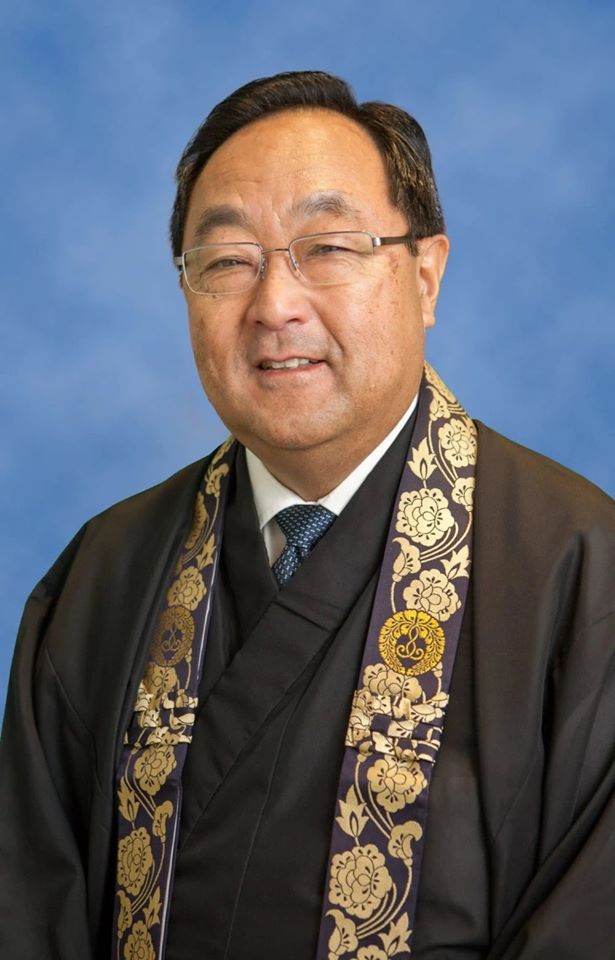
Message from Bishop Marvin Harada
Reflections on the 75th Anniversary of the Atomic Bombing of Hiroshima and Nagasaki
Rev. Marvin Harada, Bishop, Buddhist Churches of America
This month will be the 75th anniversary of the atomic bombs that were dropped on Hiroshima and Nagasaki, on August 6th and August 9th, 1945.
At the Orange County Buddhist Church, we have several survivors of the atomic bombing of Hiroshima. I have had very moving conversations with them about their experience that fateful day 75 years ago.
One of our members, Junji Sarashina, described to me that the blast knocked him completely flat on the ground on his face. Because his back was turned to the blast he wasn’t burned as badly as he could have been. He said that people didn’t even know what had hit them. No one knew what an atomic bomb was or how powerful it could be. People didn’t know the effects of radiation or anything. Parents who had missing children lost in the blast, went daily to the city trying to find their lost child. Every day that they went into the city, they became exposed to the radiation, and in a few days became sick and died.
Junji recalls coming to a river, where many people had gone into, because they were burned, but could not climb out of the river. A man reached out with his arms to ask for help, and when Junji tried to pull the man out of the river, the man’s skin came off of his arms instead. It was just unbelievable, all the devastation and suffering. In Junji’s own words, “I saw hell with my own eyes.”
Junji shared with me, “You know Sensei, I don’t believe in a hell in the afterlife, because I saw hell with my own eyes, that day in Hiroshima. There can be no greater hell than what I saw that day of the atomic bomb.”
Isn’t that true? Isn’t the hell of various religions, the construct of man, saying that these people or those people fall into hell. It is a reflection of the unenlightened man that discriminates and judges others.
For someone like Junji, such talk is absurd. Only someone who has seen hell with their own eyes, can say something like that.
In contrast to that, Junji also shared something very profound with me. He said, “You know Sensei, I also feel the same about the Pure Land. I don’t think of the Pure Land as a place I will go after I die. Sometimes I am having an enjoyable dinner with my family, with my grandkids, and I feel like, isn’t the Pure Land right here and now? If I can see hell with my own eyes, why can’t I also see the Pure Land?”
I thought that was a very profound statement by Junji. The issue of whether the Pure Land is something we can know in this life or not is a highly debated issue in Jodo Shinshu, but I tend to side with the viewpoint of Junji. Actually, there are numerous great Shin Buddhists who have that same sentiment. The Myokonin, Saichi, in his poems, writes,
I cannot fall into hell.
Hell is right here.
This place is hell,
And hell is where we dwell.
Where is Saichi’s Pure Land?
Saichi’s Pure Land is right here.
Where is the borderline of the Pure Land in this world?
The eyes are the borderline of the Pure Land in this world
Where is Saichi’s Pure Land?
Saichi’s Pure Land is in my heart.
It is, it is,
Namu Amida Butsu.
This floating world is wretched,
But this floating world becomes the Pure Land.
I’m joyful
Namu Amida Butsu.
In this world I enjoy the Pure Land.
This world transforms into the Pure Land.
I’m joyful
Namu Amida Butsu.
As we pause to reflect on the atomic bombing of Hiroshima and Nagasaki 75 years ago, may the experiences and memories of those who survived that day, be the words of wisdom to the whole world, as they implore all of humanity to live in peace and harmony.
Shinran Shonin said, “May the Buddha Dharma spread, and may the world be at peace.” 750 years ago, Shinran Shonin aspired for a world of peace and harmony. 75 years ago, after the bombing of Hiroshima and Nagasaki, those survivors aspired for a world of peace and harmony. And still today, in 2020, we too aspire for a world of peace and harmony.
Namuamidabutsu,
Rev. Marvin Harada
Bishop
Buddhist Churches of America
Statement in Support of Black Lives Matter and in Opposition to Racism
Statement in Support of Black Lives Matter and in Opposition to Racism

Today we find ourselves in a time of deep unrest and pain. There is no justification for the killing of George Floyd, of Ahmaud Arbery, of Breonna Taylor. These and other countless racially motivated misuses of force against Black people are a travesty that must not continue. The pain and anguish of the Black community is resounding throughout the United States and the world, and is touching the hearts of many more people, including our own ministers and members.
Amida Buddha is said to have the “Wisdom of Non-Discrimination.” This is manifested in the Great Compassion that embraces ALL beings. Amida Buddha does not reject anyone based on age, gender, class, race, or any other basis. Although it is difficult for us as unenlightened beings to manifest this Wisdom of Non-Discrimination, this radical equality is an ideal in our tradition. Although it is difficult for us as foolish beings to manifest the all-embracing Great Compassion, this kindness and caring is our model to strive for. However, this equality will never be reached until Black Lives Matter.
Buddhists are not immune from racism. The insidious influence of racism is learned from many sources, usually unconsciously. It is important for us as Jodo Shinshu Buddhists to engage in self-reflection, and to be open to finding this racism within ourselves, as well as within our temples.
With the Buddha Dharma as our guide, let us help with the work to dismantle systemic and institutionalized racism, both within ourselves and our organization and in the community around us.
Rev. Harry Gyokyo Bridge
On behalf of the Buddhist Churches of America Ministers Association
“The Power of Words”

Rev. Melissa Opel to speak on the “The Power of Words”
August 1st 10:00 AM
Rev. Melissa Opel will be one of the panelists on the Spokane FāVS Zoom Coffee Talk on Aug 1st. Registration is required so that they don’t get Zoom bombed; register at (www.Facebook.com/SpokaneFaVS).
The words we use, in conversation and on social media seem especially powerful right now, as we grapple with a pandemic the president has labeled “The Chinese Virus,” and as many Americans join in the Black Lives Matter Movement and continue to fight for equality.
On the first Saturday of every other month, SpokaneFāVS hosts “Coffee Talk,” which is a community forum about issues of faith and ethics. They are currently holding these forums on-line.
BCA Virtual Obon Dance
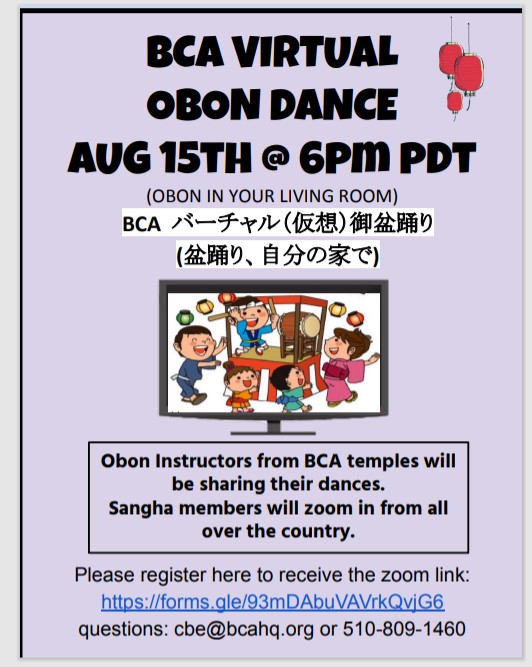
Our Izumi Pierce is included in the BCA Virtual Obon on August 16th. Be sure to register.
Jacqui Izumi Pierce

The Spokane Buddhist Temple is indeed fortunate to have Jacqui Izumi Pierce, a qualified Obon dance instructor, in our sangha. Jacqui’s new name, Izumi, means “Water Fountain.” Recently she shared a little of her background.
Izumi grew up in Los Angeles and has been interested in dancing since childhood. During her school years, she studied several styles of dance including ballet, tap, Flamenco, aerobic, and modern jazz. Dancing was (and still is) her passion.
She became interested in traditional Japanese folk dancing and Buddhism, following the sudden passing of her older brother. He was a prominent artist and musician in the LA area. Because of his interest in Buddhism, the family decided to hold his memorial service at the West Los Angeles Buddhist Temple. At the memorial service, Izumi observed a group of people practicing a dance number for their upcoming Obon festival. She was immediately drawn to this new dance and resolved to learn more. After joining the West Los Angeles Temple, she embraced the Shin Buddhist way of life and began looking for a dance instructor.
Eventually, Izumi became a student of Sensei Hisame Wakayagi, of Wakahisa-kai. Sensei was one of the founders of the Wakayagi school of traditional Japanese classical and folk dancing. Izumi has studied with her for the past 17 years. Recently, Izumi was awarded Jyun Natori, a recognition of her attaining entry-level status in the Wakayagi school of dance.
She moved to Spokane in 2016 and joined our temple family the following year. Since then, she’s become a tireless promoter of dancing at our annual Obon Festival. She brings a joyful exuberance to her teaching which carries over to her students. Every year, more people sign up to learn the dance routines. “Dancing is such a fun activity,” she says, “moving the body in time with music helps build physical coordination, mental sharpness, and emotional wellbeing.”
Once the Covid pandemic subsides and things return to normal, Izumi envisions a time when she can teach ongoing classes in the arts of Japanese classical and folk dancing at the Spokane Buddhist Temple. Until then, she is considering offering classes online using the popular zoom format.
Izumi is included in the BCA Virtual Obon on August 16th. Be sure to register.