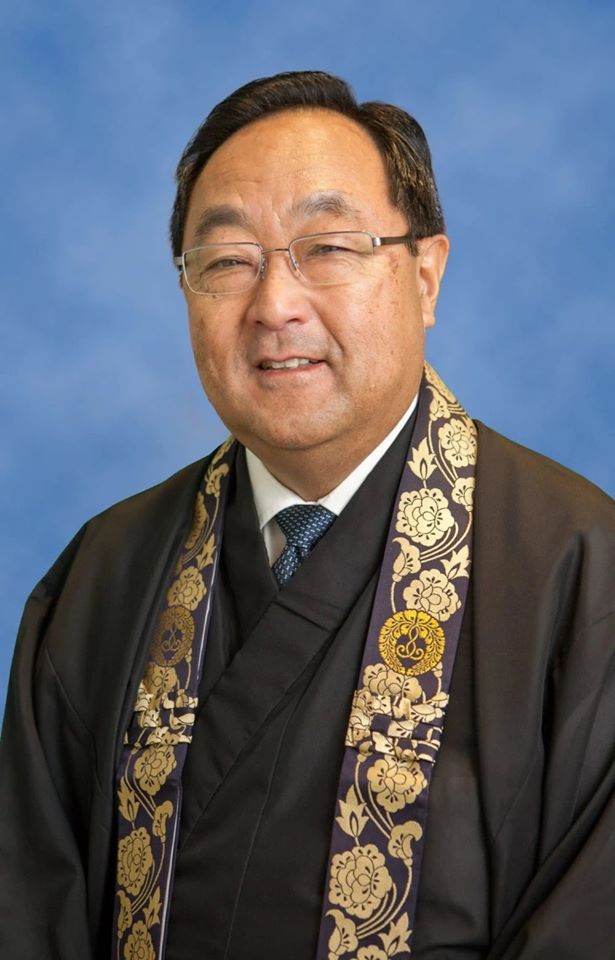
Register for Zoom Lecture

Northwest District Presents a Zoom Lecture:

Passing the Torch to the Next Generation: Lessons to be learned from
Jewels: An Introduction to American Buddhism for Youth, Scouts and the Young at Heart (With a Bit of Humor)
                   with Guest Speaker Prof. Kenneth K. Tanaka

Professor Emeritus of Musashino University in Tokyo, Japan, and a Jodo Shinshu priest; author of Ocean: An Introduction to Jodo Shinshu Buddhism in America, and a co-editor of The Faces of Buddhism in America and other books.
Zoom Lecture on Wednesday, July 22, at 7:30 PM — Registration required for password access. Register at: https://us02web.zoom.us/meeting/register/tZItcumuqzwvEt3Y2D9CmPDWK_Fl4cFs29YK
Admission is free but we kindly ask all donations be made to your local Jodo Shinshu temple. For more information please email: ysobtport1and060117@gmail.com

Message from Bishop Harada

Practical Buddhism and Truth Level Buddhism

Rev. Marvin Harada, Bishop, Buddhist Churches of America

All of the great masters and teachers in Buddhism write about and express Buddhism at a very deep, and profound level of truth. However, most of us are more interested in a more practical level of Buddhism. We ask questions like, “Will Buddhism help me to live a happier life? Will Buddhism help me to ease my stress and anxiety? Will Buddhism help me to live a more meaningful life?” We might even ask questions like, “Will Buddhism help me lower my blood pressure? Will Buddhism make me more successful in business?”

We might encounter a “gap” between the profound, truth level of Buddhism, and where we ourselves are at the practical level. How do we bridge that gap?

There are contemporary Buddhist teachers, like the Dalai Lama, who is presenting Buddhism from this very practical side, such as in his bestseller, “The Art of Happiness.” Another writer, Dan Harris, the author of “10% Happier,” is also presenting Buddhism in a very pragmatic manner. Through meditation, he was then led to Buddhism. When someone asked him why he meditates and is into that “Eastern” stuff, he simply answered, “It makes me 10% happier.” His friend said, “Wow, I’d take that.”

I think that Shin Buddhism is behind other contemporary teachers in trying to bridge that gap between the truth level and the practical level of Shin Buddhism. Without seeing some kind of practical benefit for our life, modern man will not be interested or motivated to pursue Buddhism to the “truth” level.

But there are some things that Buddhism “won’t” get you. Buddhism won’t get you a million dollars, but it can make you “feel” like a million dollars, no matter how impoverished you might be. Buddhism won’t cure your cancer, but it can give you the spiritual strength to face, even embrace your cancer, and to accept it, whether you recover from it or not.

I would like to share an example of what it means to encounter the truth level of Shin Buddhism.

Some years ago, we lost a wonderful member at the Orange County Buddhist Church, Scott Morris, to ALS, or Lou Gehrig’s disease. ALS is one of the saddest illnesses to get, because there is no cure for ALS. If you get cancer at least there is some hope of treatment, like radiation, surgery, or chemotherapy. ALS is a very debilitating illness, as it starts first with your feet and legs, paralyzing you, then it moves up your body, to where you cannot use your hands or arms, then you cannot speak, and eventually it takes your life when you can no longer breathe.

When Scott was first diagnosed with ALS, we had just started a support group, called “Living Through Illness.” Scott regularly attended that support group. In one of our sessions, Scott was feeling sad that most likely he would not live long enough to be at his son’s high school graduation, or to walk his daughter down the aisle at her wedding someday. I thought about what I could say to help Scott, so I suggested that, while he was still able to write and use his hands, that he could write a letter to his son that he could read someday when he graduates from high school, and he could write a letter to his daughter that she could read on her wedding day.

One month passed, and at the next gathering of our support group, Scott said, “Sensei, I wrote something.” I thought that maybe he had written one of those letters, but instead he shared the following poem.

  I have ALS, — and I am grateful.
                                    I am grateful to retire early to be with my family.
                                    I am grateful I have family and friends that are so supportive and hopeful.
                                    I am grateful I can still walk and get around.
                                    When that is gone –
                                    I am grateful I can still use my hands to feed myself.
                                    When that is gone –
                                    I am grateful I can still breathe and laugh and feel.
                                    When that is gone –
                                    I am grateful I had a wonderful life.
                                    And when that is gone –
                                    Namuamidabutsu.

By Scott Morris

For Scott, Namuamidabutsu was not just a word or a recitation. It was a deep and profound truth, something that transcended even his own life and death.

That is the point where practical Buddhism and truth level Buddhism merge and become one.

Namuamidabutsu,

Rev. Marvin Harada
Bishop
Buddhist Churches of America

TEMPLE RUMMAGE SALE PLANNED FOR AUG OR SEPT

TEMPLE RUMMAGE SALE PLANNED FOR AUGUST OR SEPTEMBER
DATE TBD DEPENDING ON COVID-19 SAFETY CONSIDERATIONS

Have you been cleaning your closets while spending lots of time at home?  Please consider donating your quality items for our rummage sale.  Even though we don’t have a date set you can bring your items to the temple right now – just let me know and we can arrange a time to meet you there. Contact me at dcsterrett@yahoo.com or text me at 509-599-8378.  Thanks Celeste

We are also doing RENT A TABLE again @$20/Table. These will be outside on the grass. You set up, price and sell your own items and take home what you don’t sell.

THIS COULD LIKELY BE OUR ONLY FUNDRAISER THIS SUMMER SO LETS HAVE LOTS OF PARTICIPATION!

Message from Rev. Melissa Opel

Dear Sangha,

After much thought, consideration and discussion, the consensus for the upcoming Oshoko offering, that was set to begin in July, has been canceled. In some ways, it wasn’t an easy decision to make, and in other ways, it was a no-brainer. But what changed? For me, the biggest change was we had not moved into Phase 3 and our cases of Covid-19 are rising in Spokane County. Also, I learned that the smoke from incense carries Covid-19 particles in the air longer. It was a great lesson in the ever-changing expectations of where we are now. I think we can all agree that this pandemic has tested our desire to control, make plans, and feel comfortable. The lessons of impermanence, interconnectedness, and attachments too are a constant. 

About a month ago, Becca came home from the grocery store and I was so disappointed that many of the items I had asked for were not in her bags. At first, I thought she had been forgetful in getting key ingredients for meals and I had already had a long day. When I told her I didn’t feel thought about, she reminded me that things were sold out and we can’t just have what we want right now. I cried. Not because I would miss out on a sandwich I wanted to make, or a beverage I wanted to drink, it was the fact that life was and is so different than what I am used to and it feels chaotic and unknown. Perhaps this is why our experience with the Dharma is the most important feature to the teachings. Our experience allows us to put the teachings into our own perspective. It’s a fact that items were sold out, but it was also true that despite that being a completely rational reason, I cried and felt like there was some mistake made. I filtered it through my own thoughts and feelings. It took a while for me to accept that when Becca came home with the groceries, there might not be everything I asked for or needed at the time—I’m sure those of you who were out of toilet paper or dangerously close to it can relate. Sometimes it takes a while for the truth to sink in and I have to wrestle with it for it to become true for me. How we wrestle with the Dharma is up to each of us. When I am confronted by things I don’t like, don’t want to hear, or maybe don’t understand, I have to remember that the teachings aren’t wrong, and I am not broken either. I need to figure out where it sits in my life, what it means to me, what parts of my thinking it challenges, etc. 

When it came to canceling Oshoko, the teachings reminded me that what I do affects others, and that thought can work to both reopen the Temple or not reopen the Temple. Ultimately, the decision I came to was filtered through my understanding of the science being offered to us right now, but the science can change. In that same regards, as we deal with Covid-19, the science will continue to change and how we deal with protecting each other will also change. In that way, we are like the science and laws. We will change as we evolve and receive new information. But the Dharma is steadfast and does not change. It is a constant. What changes is how we interpret our practice. So, in this uncertain time, it is okay to take each day as it comes and try to figure out where I am in understanding the world around me. I can change my mind as new information becomes available and I can be sad or angry when I don’t like the new information too. But keep yourself grounded in the dharma, remember to say nembutsu and keep practicing gratitude and deep listening. These are the things that are true and real in our uncertain world.

Namo Amida Butsu
In Gassho,
Rev. Melissa Opel

Message from Bishop Harada

The Light from a Star

Rev. Marvin Harada, Bishop

For many years I had the great fortune of serving with Rev. Akio Miyaji, who is now retired and living in Japan. Often in his funeral sermons, Rev. Miyaji used to share a true story about an experience he had many years ago while serving at the Seattle Betsuin. While serving there, he had to conduct a very sad and tragic funeral for a young Japanese couple who were both killed in a car accident while traveling to go skiing. This couple had a young son, only 7 or 8 years of age. The boy survived the accident, but the parents didn’t. After the funeral service, the little boy went up to Rev. Miyaji and asked him the question, “Where did my parents go? Where are my parents now?” Such a sad and difficult question to answer to a young child who had lost both of his parents.

Rev. Miyaji could have given a doctrinal answer like they are in Nirvana, or they are in the Pure Land, but instead, he took the little boy outside of the temple, and he pointed up in the night sky. He pointed to a very bright star shining in the evening sky. He said to the boy, “Your parents are there. They are that bright star. When you miss your parents, just look up at the shining star and you will be with them.” The boy seemed to be consoled. He returned to Japan to be raised by his uncle.

For years and years, every New Years, Rev. Miyaji used to receive a Season’s greeting card from that boy, who had grown up to be a young man. He used to write in his card, “Sensei, I have never forgotten that lesson that you gave me that night at my parents’ funeral.”

When I attended college at the University of Oregon, I took a class on Astronomy, as an elective. It was a fascinating class in which we learned about planets and stars and galaxies. I remember learning that many of the stars that we see at night, those stars have actually died, but because they are so far away from us, light years away, that we continue to receive the light from a star that has actually died long ago.

We might lose dear loved ones, but they too continue to give us light, like a star that has already perished, but continues to illuminate the sky.

Thich Nhat Hanh, the great Vietnamese Buddhist master, also gives a similar teaching. In one of his books, he talks about the light of a candle. A candle burns vertically, and we think that when the wax is gone, and the flame has been extinguished that the “life” of the candle is also gone. But Thich Nhat Hanh says, “No, the candle, as it has been burning, is giving out light and warmth. Even when the flame is gone, the light and warmth that the candle has been giving, continues to spread out into the world.

What a beautiful image that is for us as we live in a world that often becomes dark and cold. The light of the Buddha, the light of the Dharma, the light of wisdom, is an unobstructed light. There is nowhere that it cannot reach. There is no one or nothing that does not receive or is embraced in that light. We may not see it, or be aware of it at all times, but it reaches everywhere, even into the darkness of my own heart.

If we come to receive, to encounter that light in our lives, then like a candle, our life too will give light and warmth to others. May we come to receive, to encounter the light of the Buddha, the light of Namuamidabutsu, and may that light be shared with all beings.

Namuamidabutsu,

Rev. Marvin Harada, Bishop

Buddhist Churches of America
New Book & Workshop from Rev. Tanaka

New book by Reverend Tanaka:

Jewels: An Introduction to American Buddhism for Youth, Scouts and the Young at Heart  (With a Bit of Humor) by Kenneth Kenshin Tanaka

 Message from Kenneth Tanaka:

1)    It is published by BDK America (Society for the Promotion of Buddhism). I chose this publisher because my interest is to share the teachings, rather than making a profit from the book. https://www.bdkamerica. Org

2)   The pdf version of the book can now be downloaded here for free:

 https://www.bdkamerica.org/ book/jewels-introduction- buddhism-youth-scouts-and- young-heart

3)    Up to 5 printed books will be available around June and free of charge when requested by temples, schools and other organizations. Please visit the same site in June. 

4)    And for individuals, it will be available for purchase at a very modest price of $6/book, which includes cost of shipping to continental U.S. Very reasonable!

It’s my dream that this book can help Buddhist youth to gain greater confidence in their religion, and give any younger persons (whether they are Buddhist or not) a chance to take interest in Buddhism. It’s good for adults too, which is why the title includes “for the Young at Heart”!

I am especially pleased that I was able to sprinkle humor into the book. Chapter 11 is all dedicated to humor!

***REGISTER ASAP

only 100 registrations***

Message from Rev. Harada

The Light from a Star

For many years I had the great fortune of serving with Rev. Akio Miyaji, who is now retired and living in Japan. Often in his funeral sermons, Rev. Miyaji used to share a true story about an experience he had many years ago while serving at the Seattle Betsuin. While serving there, he had to conduct a very sad and tragic funeral for a young Japanese couple who were both killed in a car accident while traveling to go skiing. This couple had a young son, only 7 or 8 years of age. The boy survived the accident, but the parents didn’t. After the funeral service, the little boy went up to Rev. Miyaji and asked him the question, “Where did my parents go? Where are my parents now?” Such a sad and difficult question to answer to a young child who had lost both of his parents.

Rev. Miyaji could have given a doctrinal answer like they are in Nirvana, or they are in the Pure Land, but instead, he took the little boy outside of the temple, and he pointed up in the night sky. He pointed to a very bright star shining in the evening sky. He said to the boy, “Your parents are there. They are that bright star. When you miss your parents, just look up at the shining star and you will be with them.” The boy seemed to be consoled. He returned to Japan to be raised by his uncle.

For years and years, every New Years, Rev. Miyaji used to receive a Season’s greeting card from that boy, who had grown up to be a young man. He used to write in his card, “Sensei, I have never forgotten that lesson that you gave me that night at my parents’ funeral.”

When I attended college at the University of Oregon, I took a class on Astronomy, as an elective. It was a fascinating class in which we learned about planets and stars and galaxies. I remember learning that many of the stars that we see at night, those stars have actually died, but because they are so far away from us, light years away, that we continue to receive the light from a star that has actually died long ago.

We might lose dear loved ones, but they too continue to give us light, like a star that has already perished, but continues to illuminate the sky.

Thich Nhat Hanh, the great Vietnamese Buddhist master, also gives a similar teaching. In one of his books, he talks about the light of a candle. A candle burns vertically, and we think that when the wax is gone, and the flame has been extinguished that the “life” of the candle is also gone. But Thich Nhat Hanh says, “No, the candle, as it has been burning, is giving out light and warmth. Even when the flame is gone, the light and warmth that the candle has been giving, continues to spread out into the world.

What a beautiful image that is for us as we live in a world that often becomes dark and cold. The light of the Buddha, the light of the Dharma, the light of wisdom, is an unobstructed light. There is nowhere that it cannot reach. There is no one or nothing that does not receive or is embraced in that light. We may not see it, or be aware of it at all times, but it reaches everywhere, even into the darkness of my own heart.

If we come to receive, to encounter that light in our lives, then like a candle, our life too will give light and warmth to others. May we come to receive, to encounter the light of the Buddha, the light of Namuamidabutsu, and may that light be shared with all beings.

Namuamidabutsu,

Rev. Marvin Harada, Bishop
Buddhist Churches of America