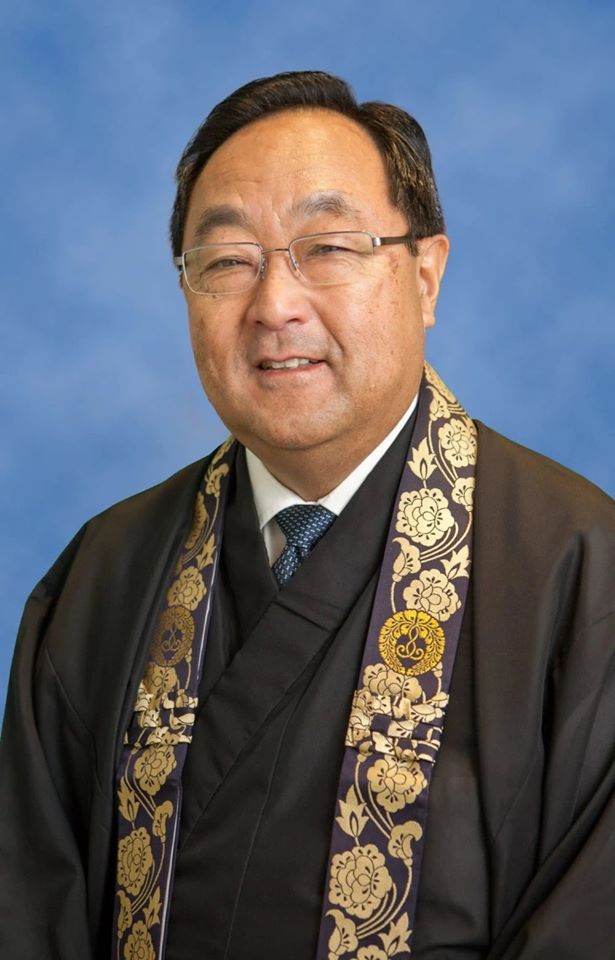
Message from Bishop Harada

Message from Bishop Marvin Harada: The Color of Pure Gold

The Color of Pure Gold

“If, when I attain Buddhahood, humans and devas in my land should not all be the color of pure gold, may I not attain perfect Enlightenment.
                                                      — Larger Sutra of Immeasurable Life

Our world today faces racial tension and racism that tears at our humanity and society.

We watched in horror as George Floyd was choked to death by a policeman. People have marched in our cities — both large and small — throughout the world to protest racism, police brutality and injustice. It almost feels like we haven’t made any progress since the 1960s and the days of the Civil Rights Movement.

It is my hope and wish that progress can be made, that there will be a day when we won’t have to protest for equality and justice.

Such an aspiration is at the heart of the Buddha, as is expressed in the above quote, which is the third of the 48 vows in the Larger Sutra.

We don’t interpret this vow literally. It is not saying that we all have to have the same golden tan and color of skin. This vow is expressing what is at the heart of a Buddha, the heart of an Enlightened One that sees “beyond” the color of our skin, such that all beings reflect the “color of gold.”

May we strive to create a society and world that is based on that kind of aspiration, a world of oneness, an interdependent world that is made up of all sentient beings, a world beyond discrimination and distinctions, a world in which all beings reflect the color of gold.

Namuamidabutsu,Rev. Marvin Harada
Bishop
Buddhist Churches of America

Statement in Support of Black Lives Matter

Statement in Support of Black Lives Matter and in Opposition to Racism

Today we find ourselves in a time of deep unrest and pain. There is no justification for the killing of George Floyd, of Ahmaud Arbery, of Breonna Taylor. These and other countless racially motivated misuses of force against Black people are a travesty that must not continue. The pain and anguish of the Black community is resounding throughout the United States and the world, and is touching the hearts of many more people, including our own ministers and members.

Amida Buddha is said to have the “Wisdom of Non-Discrimination.” This is manifested in the Great Compassion that embraces ALL beings. Amida Buddha does not reject anyone based on age, gender, class, race, or any other basis. Although it is difficult for us as unenlightened beings to manifest this Wisdom of Non-Discrimination, this radical equality is an ideal in our tradition. Although it is difficult for us as foolish beings to manifest the all-embracing Great Compassion, this kindness and caring is our model to strive for. However, this equality will never be reached until Black Lives Matter.

Buddhists are not immune from racism. The insidious influence of racism is learned from many sources, usually unconsciously. It is important for us as Jodo Shinshu Buddhists to engage in self-reflection, and to be open to finding this racism within ourselves, as well as within our temples.

With the Buddha Dharma as our guide, let us help with the work to dismantle systemic and institutionalized racism, both within ourselves and our organization and in the community around us.

Rev. Harry Gyokyo Bridge
On behalf of the Buddhist Churches of America Ministers Association

Dharma Discussion is on Wed. this week (6/10)

Join Sensei Melissa Opel & Sangha Members for a “Zoom”

DHARMA DISCUSSION WEBINAR

Thursdays 6:30 pm ****WED 6/10 THIS WEEK***

It’s been a joy to see Sangha members & hear how they are doing.

Join in by emailing Sensei Opel at Melissajoshinopel@gmail.com

You’ll be notified of the Dharma Discussion login by email.

Dharma Discussions Every Thursday

Join Sensei Melissa Opel & Sangha Members for a “Zoom”

DHARMA DISCUSSION WEBINAR

Thursdays 6:30 pm

It’s been a joy to see Sangha members & hear how they are doing.

Join in by emailing Sensei Opel at Melissajoshinopel@gmail.com

You’ll be notified of the Dharma Discussion login by email.

Message from Bishop Harada: Losing Our Sense of Humanity

Recent current events have shown me how easy it is to lose our sense of humanity, our sense of being a human being. First, we saw the appalling video of the policeman in Minnesota sitting on George Floyd, to the point that he suffocated. If you have a sense of humanity, you cannot sit on top of a person until they can no longer breathe. I think it would be hard to do that to any living thing. But then, over the weekend, we saw peaceful demonstrations turn into riots and looting. There were also cases of peaceful demonstrations that remained that, peaceful and meaningful demonstrations of people expressing their right to speak. However, we also saw people who lost their sense of humanity, by choosing to break windows, set fires to buildings and cars, and to steal and loot from businesses. Those businesses are owned by regular people, regular human beings like you and I, who work hard to make a living. How can you steal from another human being like that unless you lose your sense of humanity?

How do we find our sense of humanity, and most importantly, keep it, even when we are angered, bitter, or disappointed? The Shin Buddhist lay teacher, Hideo Yonezawa, wrote that the path of Shin Buddhism is the path to “becoming human.” We might think that we are human already, but Yonezawa Sensei points out that without finding the Dharma, we are not living a life as a true human being, that we have not found our sense of “humanity.”

Perhaps you have heard of the teaching of the six realms of existence, starting from the heavenly realm, then the human realm, the animal realm, and followed by the realms of the fighting demon, the hungry ghost, and the lowest realm, the realm of hell. During the time of Shakyamuni Buddha, people in India looked at these realms literally, that if you didn’t live a good life as a human that you would fall into a lower realm in your next life. Shakyamuni Buddha reinterpreted this world view and saw how these realms were teaching about our inner life, our psychological life. In one day, even in one hour, we could touch on several or all of these realms. We can go from a euphoric state of heaven, and fall all the way to the depths of hell. We fall into the fighting demon realm when we fight with traffic, or with our boss, or with a family member. We fall into the realm of the hungry ghost when we are greedy or are never satisfied.

One temple member that I know is a survivor of the atomic bomb in Hiroshima. In a conversation one day, he shared with me that he doesn’t believe in hell in terms of an afterlife. He said, “That day in Hiroshima, I saw hell with my own eyes. There can be no other hell as horrendous as what I saw that day.”

When we reflect on these six realms, we have to ask ourselves, how much of the day am I in the human realm? Maybe not so much. Maybe not hardly at all. As we have seen, it doesn’t take much to lose our sense of humanity. First, we have to see how we are caught in the vicious cycle of the six realms. Then, we must seek the teachings, the way to get out of that vicious cycle.

To see such terrible things occurring in the world gives us all the more reason to listen to the teachings, to follow the path of the Nembutsu, to find our truest sense of humanity. We have to first find our sense of humanity, and then not lose that sense of humanity. When we find our true sense of humanity, that humanity will then spread to others.

Namuamidabutsu,

Rev. Marvin Harada, Bishop
Buddhist Churches of America

Message from Bishop Harada: Patience, Patience

PATIENCE, PATIENCE
Rev. Marvin Harada, Bishop

In Buddhism we have the teaching of the Six Paramitas, the six bodhisattva practices that carry us from this shore of samsara, to the other shore of truth or enlightenment. Today I would like to reflect on the second paramita, which is “patience.”

In Buddhism, we have to have patience in following the path. As they say, Rome wasn’t built in a day. We can’t expect to understand it all in a day or two. It takes time and patience. When young people first take a martial art, like Karate, right away they want to know, “How long will it take me to get my black belt?” It takes years to earn a black belt and it takes time to come to understand the heart of the Buddha-Dharma. How long you might ask? One year? Two years? Five years? I would say that it takes our whole life. Listening and learning in Buddhism is a lifelong enterprise. It is a lifelong undertaking.

The great Buddhist thinker, D.T. Suzuki, who is perhaps most responsible for introducing Buddhism to the west, when he was 95 years old, he had a five-year plan for what he wanted to study and research. For D.T. Suzuki, his study of the Dharma was a lifelong undertaking.

During this Coronavirus pandemic, I think that the word “patience,” takes on a new meaning. It feels like many people are reaching the “breaking point,” meaning that they are so sick and tired of being cooped up and not able to go out to restaurants, to bars, to stores, to the beach, that they are on the verge of exploding. Maybe that is why when about a week ago when they opened up the beaches in our area in Orange County, people flocked to the beaches.

This is a time in which as Buddhists, we can apply our teachings to help us face and endure this difficult, stressful, and anxious time. We can practice patience. We have to stick it out. We have to endure a little more this stay at home time, to help prevent the spread of the virus, or else it might become even more worse and deadly.

But it is not easy. Personally, I am dying to go to Las Vegas, but of course it is closed still. It seems like another lifetime ago that we went to Vegas and enjoyed the restaurants, the casino, and the shows. But we have to be patient, and we have to endure.

We might need to practice patience at home. Family members might be getting on each other’s nerves. Parents are trying to work from home, do home schooling for their kids, and not have any outlet of going out and getting away for a spell.

I heard a funny statement from someone who said, “Well, we haven’t killed each other yet,” and I know this was a joke, but we can all relate to that to some extent, can’t we? Truly, everyone’s patience is being tested during this shelter at home period.

I recall a wonderful quote from the novel, Siddartha, by Herman Hesse, which is a classic novel. In the novel, the main character, Siddartha, experiences renunciating the secular world, much like the historical Buddha did. During his time of religious practice, he didn’t have material things like a home, nice clothes, or three meals a day. But Siddartha said, “I can think. I can wait, and I can fast.” That was what he was able to do.

I cannot fast for even one day, but I think that all of us can do the other two, we can think, and we can wait. It might not be easy, but we can wait this out, we can practice patience. It might last a long time, but it won’t last forever. If we can wait, we will be able to endure it.

May we choose this time to practice patience, patience and more patience.

Namuamidabutsu,

Rev. Marvin Harada, Bishop, Buddhist Churches of America